Relationship Expert Reveals a Simple 14-Day Method That Helps Women Reclaim Their Identity — Without Losing Themselves in Love

You still remember who you were before him.
The woman with plans. Big plans. A five-year vision board she actually believed in. Morning routines she protected. A group chat that was always lit. Friends who knew her stories.
Then love walked in.
And slowly — so slowly you barely noticed — she started to disappear.
First it was the Sunday morning journalling. Then the gym sessions. Then the girls' dinners. Then the business idea you kept saying you'd "circle back to." Then the version of yourself who had opinions, dreams, and boundaries that weren't built around one person.
You told yourself it was normal. That this is what love requires. That you were just being a good partner.
But somewhere between the second year and the third, you looked in the mirror and asked yourself something that still stings:
Where did I go?
You are not lazy. You are not ungrateful. You are not dramatic. You are a woman who loves deeply — and nobody warned you that loving deeply, without an anchor, can mean quietly erasing yourself.
Your goals are still there. Waiting. Your friendships still exist — just quietly wounded. Your ambitions haven't left. They've just been waiting in a room you stopped entering.
And the relationship? Maybe it's good. Maybe it's not. But either way, you cannot give from a place of emptiness. You cannot be a whole partner when you have stopped being a whole person.
If you have been silently asking yourself, "When did I become the woman who put everything on hold for love?" — drop everything you are doing now and read every word on this page.
Because I am about to share with you something that changed my life. And it might change yours too.
"I know. Because I carried it too."
There is a quiet truth that older women understand — one that younger women are rarely taught before it is too late.
A healthy relationship does not ask you to disappear into it. It makes room for two whole, living, breathing people. Not one person and the shadow of another.
Our mothers knew this. Our grandmothers, in their own imperfect ways, understood that a woman who loses herself in love eventually loses the relationship too. Because the woman he fell in love with is no longer there.
My name is Amara Okafor.

I am not a therapist. I am not a certified relationship coach. I hold no framed qualification on my wall. What I am is a 31-year-old Nigerian woman who spent the better part of three years learning, the hard way, what it costs a woman to love without keeping herself.
How I Lost Myself — and Found the One Method That Brought Me Back
I grew up in Lagos. And growing up, I had an image of what love was supposed to look like. I had seen it in the relationships around me — women who adjusted, softened, made room. I thought that was the shape of commitment.
So when Emeka came into my life, I was ready. Ready to love. Ready to build. Ready to be a good woman.
What I was not ready for was the slow, quiet erosion of everything I was before he arrived.
It started with small things. I cancelled a friend's birthday dinner because he was having a rough week and needed company. I skipped my Saturday online course because he had booked a surprise trip. I told myself, it's fine, I'll catch up. And I did believe that. At first.
Then came the medium things. I stopped writing in my journal because I didn't want him to think I was "overthinking." I let my business idea sit untouched in a Google doc for six months. Seven months. Eight. I told myself it wasn't the right time. When things settle. When we have more stability.
Then came the bigger things. My closest friend, Chisom, stopped calling as often. We had grown apart — not because of a fight, but because I kept rescheduling until she stopped reaching out. Two other friendships faded the same quiet way.
I was in a relationship. I was not alone. But I was lonely in a way that is very hard to explain — the loneliness of not recognising yourself.
The worst part was not that Emeka had asked me to change. He hadn't, not directly. The worst part was that I had done it all on my own. One small sacrifice at a time. Each one felt like love. In total, they added up to self-abandonment.
I tried to fix it on my own. I really did.
I tried working harder to keep him happy — adjusting more, giving more, being more. But the more I poured out, the more hollow I felt inside. It was not sustainable. It was exhausting in a way that sleep could not fix.
I tried putting everything on "later." — I promised myself I would return to my goals once things were less busy. But later kept moving. Six months became a year. A year became two.
I tried ignoring the feeling that something was missing — telling myself that a good relationship should be enough. But ignoring your own needs does not make them disappear. It just means they go underground and come up as resentment, restlessness, or sadness you cannot name.
I slowly withdrew from my friends — thinking it would reduce the relationship tension. Instead, my world became smaller. I had one person and nothing else. That is not love. That is dependence.
I tried to become the "perfect girlfriend" — moulding myself into what I thought he needed. But when you keep editing yourself for someone else's comfort, you eventually publish a version that isn't you.
I waited for motivation to return — thinking one day I would just wake up feeling like myself again. That day did not come. Not until I had a structure. Not until I had a method.
It was a Thursday morning when I almost did not go to the workshop.
There was a small women's leadership and personal-growth event in Lagos — the kind that circulates on Instagram stories and you screenshot but rarely actually attend. Emeka and I had loosely planned to spend the day together. I was already preparing to cancel my spot.
But something made me go. A quiet nudge I could not explain.
The workshop itself was good. Clear. Practical. But it was not what happened inside the room that changed my life. It was what happened in a corridor afterward — a short conversation with a woman named Mrs. Nneka Adeyemi.
She was 52. Calm in the way that only women who have lived through something become calm. Warm, but not soft. She had been in the room during the session and had noticed, she told me later, that something about the way I carried myself did not match the brightness in my eyes when I spoke.
She walked up to me with a cup of tea in one hand and a quiet smile, and she said:
"You seem like a woman who has a lot going on inside herself — but she keeps talking about someone else."
I laughed. The way you laugh when something cuts close.
She asked me one question. One. And I have thought about it almost every day since.
"If your relationship is going well, but you are no longer living your own life — can you really say you are okay?"
I did not have an answer. Because the answer was no. And I had been avoiding that answer for two years.
We sat together for forty minutes. And in that time, Mrs. Nneka Adeyemi said things to me that no blog, no Instagram quote, no therapy podcast had ever said quite so plainly.
She wasn't speaking in theories. She was speaking from having watched this pattern repeat, in women around her, for decades.
I sat with that for a moment. And then she said something that will stay with me for the rest of my life:
"You were not too much. You were not too needy. You were a woman without an anchor. And a woman without an anchor doesn't drift out of love. She drifts out of herself."
I cried. Not politely. Not one tear falling gracefully. The real kind — the kind that builds up over months and breaks through when someone finally says the thing you did not know you needed to hear.
Here is the thing nobody tells women about love:
When you enter a relationship, your identity does not automatically hold its shape. Without deliberate effort, it bends. It accommodates. It adjusts to fit the space the relationship occupies. This is not weakness. It is not failure. It is what happens when love is powerful and your sense of self has no structure to hold it.
The problem is not that you loved too much. The problem is that your identity had no anchor. No four fixed points. No boundaries you protected, goals you returned to, friendships you maintained, or personal practices you kept alive.
And so, slowly, love became the whole map. Instead of one beautiful part of a life, it became the entire life. And when the relationship had a hard week — or a hard year — you had nothing else to stand on.
It is not a love problem. It is an identity structure problem. And structure can be built.
She called the framework she had developed over years of observation the Identity Anchor™ Method.
It was not about becoming distant. It was not about loving less. It was not about becoming self-centred or difficult. It was about protecting four specific areas of your life — deliberately, consistently — so that love could exist alongside who you are, instead of replacing who you are.
She wrote it down for me on a piece of paper. Seven steps. Fourteen days. Simple enough to start that evening.
The First Few Days: Nothing
Day one. I did the first exercise. Wrote down the four areas. Looked at what I had abandoned in each one. Put the paper away.
Day two. I re-read the paper. Added three things I had forgotten. Felt the discomfort of seeing it all written down in one place.
Day three. Something shifted. Not in my life — not yet. In my awareness. I began to notice the moments I defaulted to him when I could have chosen myself. The small surrenders I had stopped seeing because they had become habit.
Day four. I almost stopped. I told myself I was overthinking it. That maybe I was making the relationship into a problem when it wasn't. I nearly put the paper in a drawer.
I remembered what Nneka said: The discomfort in the early days is not a sign that it isn't working. It is a sign that you are finally paying attention.
Day 7: The First Sign
I sent Chisom a voice note. Just hello. Just checking in. Just — I was thinking about you. She replied within minutes. We talked for an hour. At the end of the call, she said, "You sound more like yourself."
I also returned to something I had abandoned: a small online writing project I had set up eighteen months earlier and had not touched since. I spent thirty minutes on it. Just thirty. But thirty minutes of doing something that was entirely mine felt enormous.
Day 10. Day 11. Then Something Broke Open.
By Day 10, I had created a pocket of personal time every evening. Nothing dramatic — forty minutes. But it was mine. Protected. Non-negotiable. And for the first time in a long time, I stopped feeling that low, restless guilt that something was always undone inside me.
Day 11, I set a boundary I had avoided setting for over a year. Calmly. Clearly. Without drama. And the world did not end.
By Day 14, I caught myself in the middle of an ordinary Wednesday thinking about my plans for the next three months. My plans. Not ours. Mine. And I realised I had not done that — just thought freely about my own future — in longer than I could remember.
And then there was the moment that still gets me.
"I forgot to check. For the first time in years, I woke up and my first thought was not about the relationship. It was about me. That was the moment I knew something real had shifted."
But the real test was still coming.
The Conversation That Changed Everything Between Us
One Sunday evening, Emeka looked at me across the room and said something that surprised me.
"Are you pulling away from me?"
There was a time when that question would have sent me spiralling. When I would have immediately softened, apologised, rearranged myself to reassure him. Instead, I paused. And I said something I had been practising inside myself for fourteen days:
"No. I'm learning how to be with you without disappearing from my own life."
We talked for a long time that night. He told me, eventually, that he had not actually wanted the version of me who abandoned herself for him. He had fallen in love with the woman who had her own fire. He had just not known how to say it. And I had not known how to keep it.
"He said, 'I didn't want you to stop being you. I just didn't know how to tell you that watching you shrink made me feel guilty.' We had both been losing something. We just hadn't named it until now."
I cried again that night. Not from pain. From relief. The kind of relief that comes when you stop performing a version of love that was costing you everything.
I Didn't Plan to Tell Anyone
A few weeks after I completed the fourteen days, I mentioned what I had done to one friend. Just one. Funmi, from university. I told her about the workshop, about Mrs. Nneka, about the framework. About how something had shifted that I could not fully explain but could feel in every part of my daily life.
Funmi was quiet for a moment. And then she said: "Amara, I need this. I have been losing myself for three years and I didn't have a word for it until now."
She tried the method. A week later, she forwarded our conversation to another friend. That friend sent it to her sister in London. Her sister shared it in a group of Nigerian women in diaspora. From there, it spread the way things spread among women — through voice notes and WhatsApp messages and honest late-night conversations.
And the stories that came back were almost identical in their shape.
Why I Stopped Sharing It Privately and Put It Into a Guide
For months, I shared the framework individually. Voice notes. Long WhatsApp messages. Conversations over video call. Women from Lagos, London, Toronto, Houston, Accra — each one carrying a version of the same story.
And every time, the same moment: the pause when they recognised themselves in what I was describing. The quiet relief of being seen.
But I couldn't keep up. And the method deserved more than a rushed voice note. It deserved to be written clearly, structured properly, with exercises you could actually do and a fourteen-day plan you could actually follow.
So I documented everything Mrs. Nneka Adeyemi taught me. I tested each step. I refined the language. I added the self-check exercise, the boundary framework, the daily structure, and the Identity Anchor Promise at the end.
Introducing…
— Even If You Always Lose Yourself in Relationships
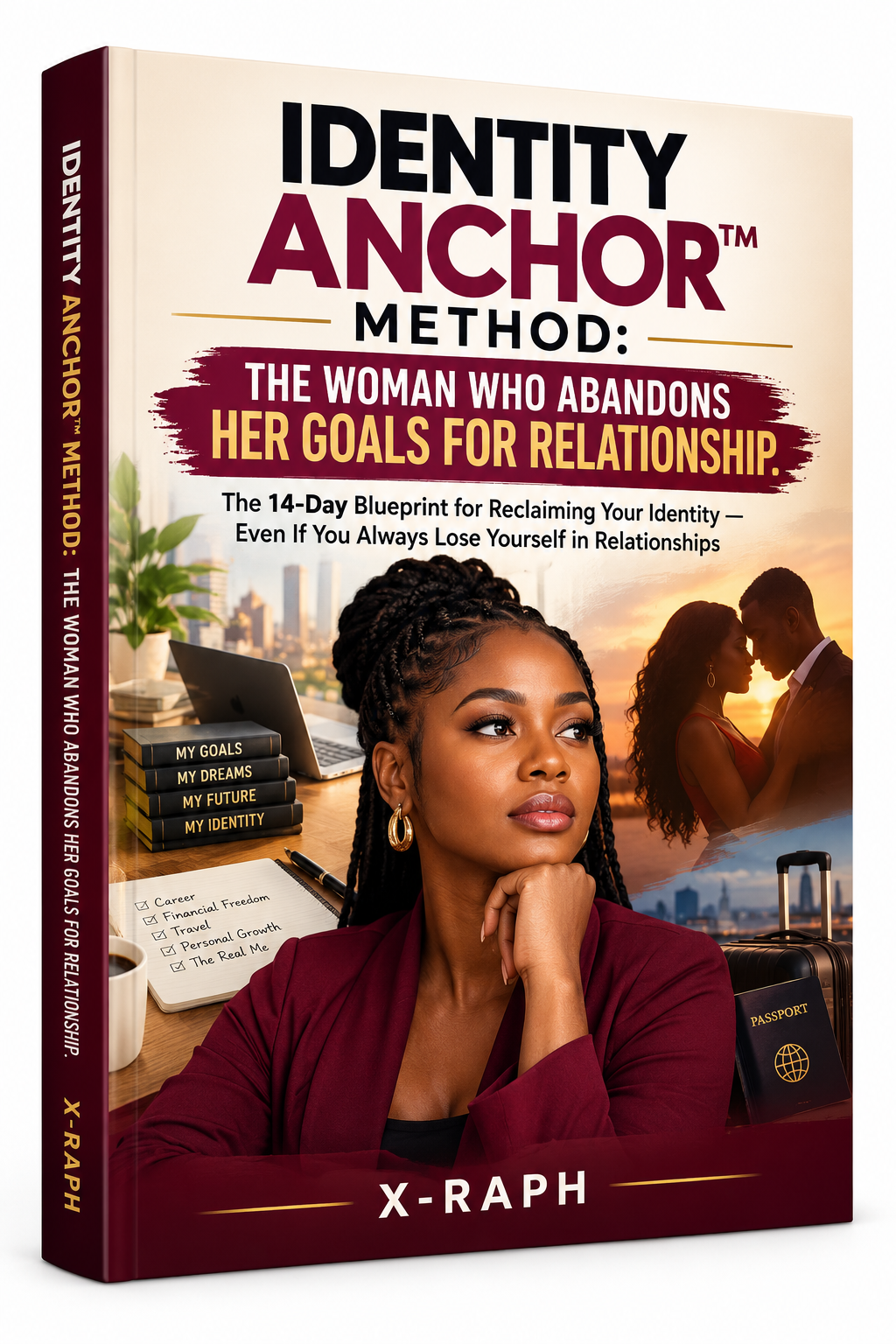
Everything Mrs. Nneka Adeyemi shared with me in that corridor in Lagos — documented, refined, verified, and written in plain language so you can begin tonight. No jargon. No complicated theory. A clear method you can use inside your real life, with your real relationship, starting right now.
What Is Inside the Guide
Inside this e-guide, you will discover:
- Page 1 — The Identity Wake-Up Call. Understand exactly how loving someone deeply can cause you to put your own identity on pause — and why it is not your fault, but it is your responsibility to change it.
- Page 3 — The 4 Identity Anchors. Discover the four areas you must protect: your Goals, your Boundaries, your Relationships outside the relationship, and your Self. Lose any one of these and you begin to disappear.
- Page 6 — The "Where Did I Go?" Self-Check. A structured reflection exercise that helps you identify exactly which parts of your life you have quietly abandoned — and when it started.
- Page 8 — Reclaiming Your Goals Without Neglecting Love. A practical framework for making space for your ambitions, your plans, and your future — without turning your relationship into a battleground.
- Page 10 — Boundaries Without Guilt. Practical, real guidance for creating and keeping personal boundaries without drama, distance, or constant conflict.
- Page 12 — The 14-Day Identity Anchor Reset. A day-by-day structure for reconnecting with your routines, goals, friendships, personal time, and sense of self — one manageable step at a time.
- Page 15 — Your Identity Anchor Promise. Create your own personal rules for protecting who you are — even when love is deep, even when the relationship is good, and especially when it is hard.
And the best part? You do not need to leave your relationship. You do not need to become cold or distant. You do not need to choose between love and yourself. This method is for women who want both — because both are possible. It is the same framework that worked for me, and has now worked for over 400 women I have quietly shared it with.
Just So You Know… Putting This Guide Together Cost Me Over ₦110,000
I want you to understand what went into this before we talk about what you will pay for it.
I am not going to charge you ₦110,000.
I won't even charge you ₦50,000.
Not even ₦25,000.
A fair price for everything in this guide would be ₦15,000 — and it would still be worth it.
But I know you are here because you are ready to do something real. And I want the price to never be the reason you don't.
This Discounted Offer is ONLY for the First 50 Women. So Don't Wait.
WAIT — I Have Something Special For You…
If you are one of the first 50 women to claim your copy today, you will also receive these two FREE bonuses alongside the guide — today only.
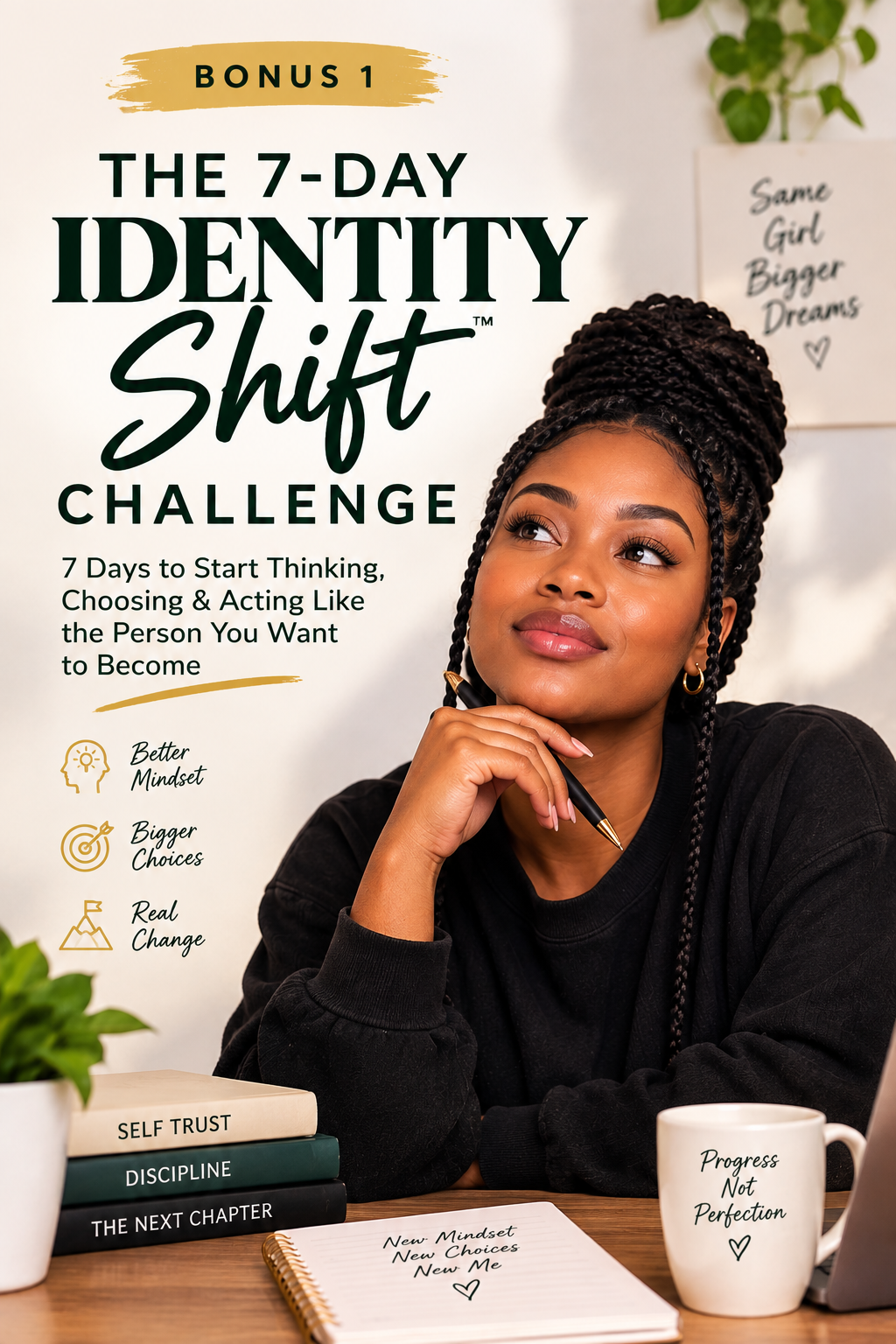
A beautiful one-page daily reminder card designed to strengthen your confidence, reconnect with your identity, and keep your goals in sight — even on the hard days. Print it. Pin it. Come back to it every morning. It takes thirty seconds to read and it recalibrates everything.
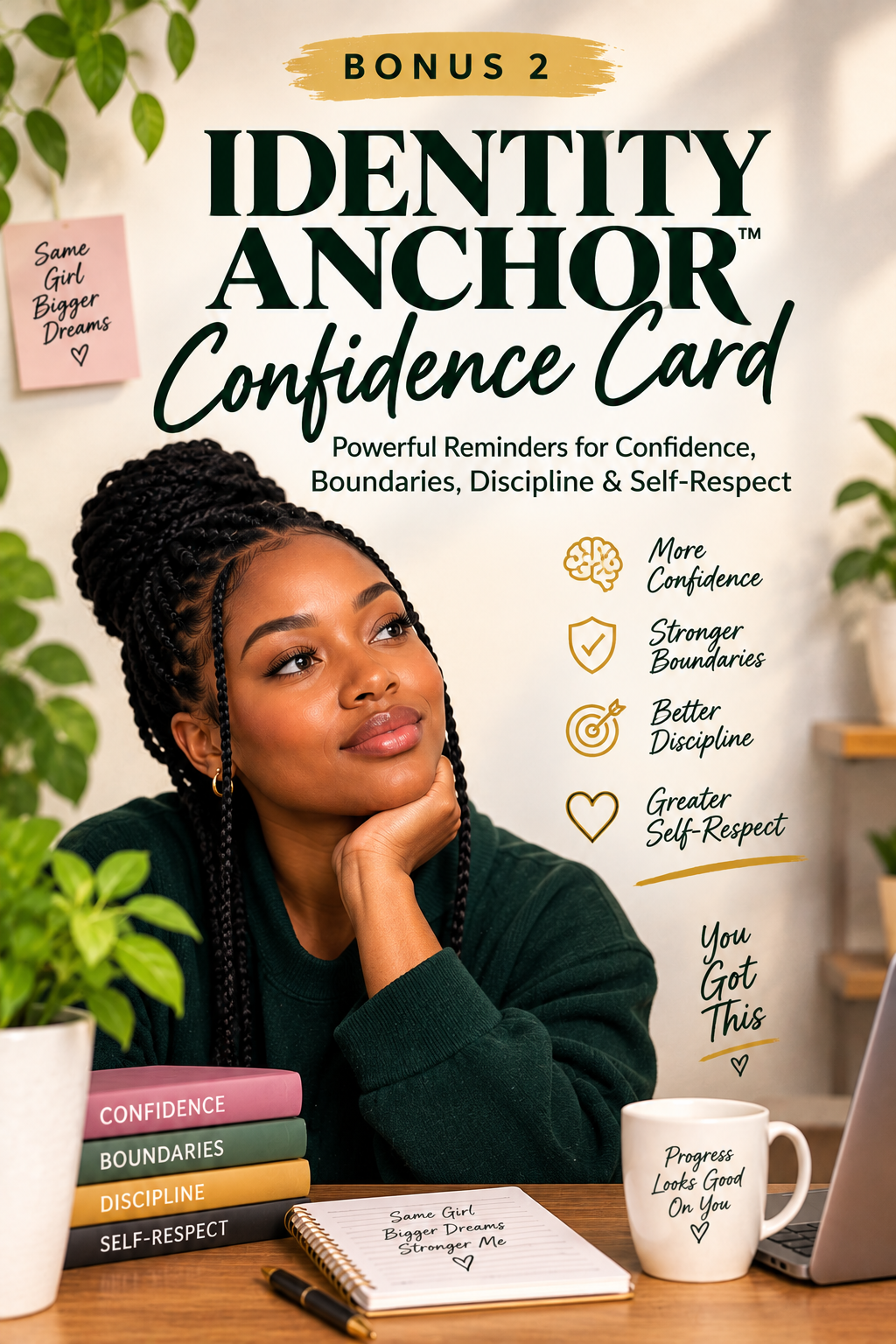
A simple, seven-day action challenge designed to help you stop abandoning yourself and start proving your new identity through daily choices. Each day has one small, specific action. Not overwhelming. Not complicated. Just consistent. Because identity is not built through one big decision — it is rebuilt through daily choices you make for yourself.
Everything You Are Getting Today
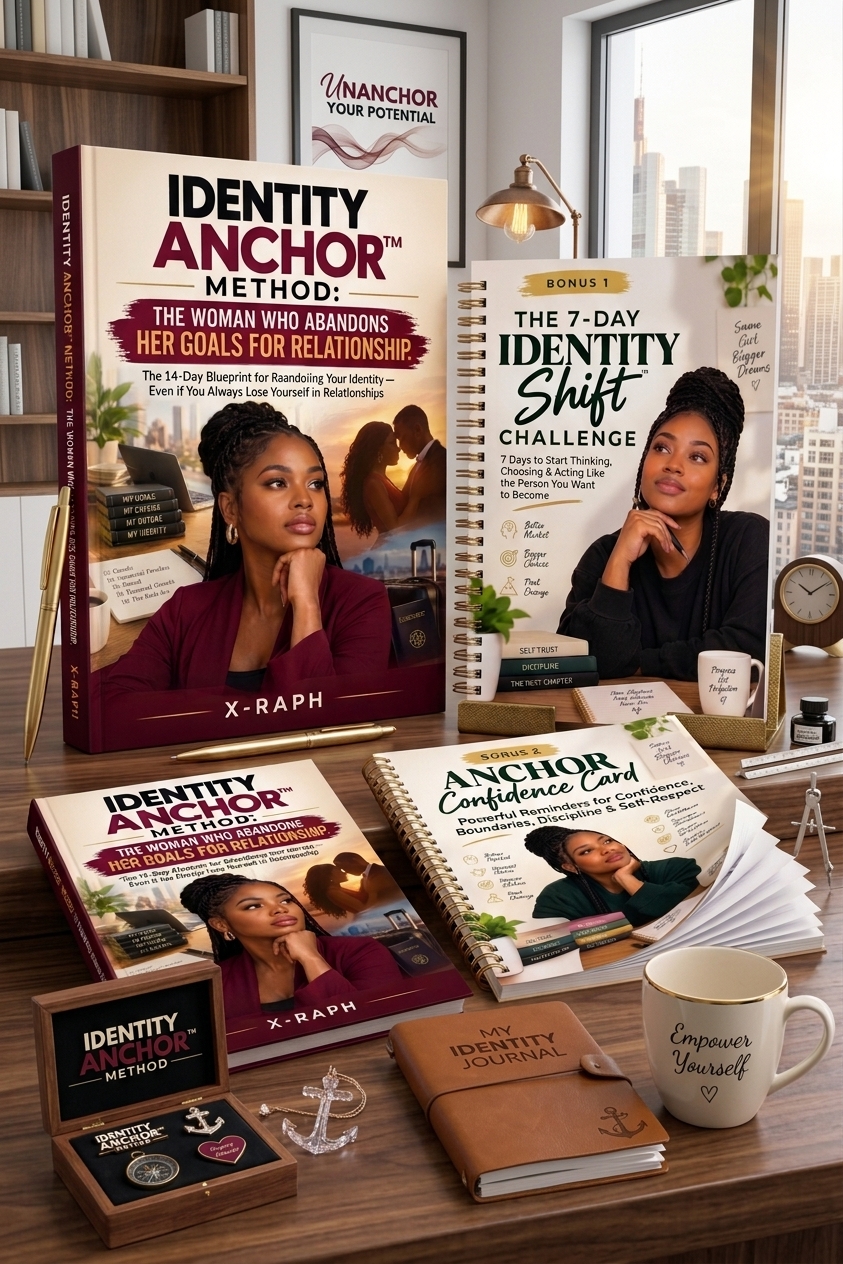
- Identity Anchor™ Method — 14-Day Blueprint PDF
₦15,000 - Bonus 1: Identity Anchor™ Confidence Card
₦3,500 - Bonus 2: The 7-Day Identity Shift™ Challenge
₦4,500
What Happens When Women Claim Their Copy
Only 7 spots remaining before the price returns to ₦15,000.
You are not the only woman reading this page right now.
🛡 30-Day Money-Back Guarantee
Still feeling unsure? I completely understand. Which is why I am making you a bold, risk-free promise.
Download the Identity Anchor™ Method. Follow the 14-day process as described. Do the self-check, work through the four anchors, and complete the daily reset. If after thirty days you do not feel meaningfully more connected to your own goals, boundaries, and sense of self — contact me for a full refund. No questions. No long emails. No proving yourself.
The only risk here is staying exactly where you are.
More Women Who Found Their Way Back
"I read the self-check on page 6 and I stopped. I just stopped and sat there. Because in that one exercise I saw clearly that I had abandoned five things in the last two years — five real things that were mine — without even realising it was happening. This guide doesn't shame you for losing yourself. It gives you a clear, kind, structured way back. That is rare. That is valuable."
"I almost didn't buy it because I thought, it's just another PDF. But this is not just another PDF. This is the practical version of all the self-love content I have consumed and never actually been able to apply. It gives you exactly what to do, when, and why. The 14-day structure is the missing piece. I have recommended it to four women already."
"My relationship is good. My partner is good. And I still lost myself. Nobody prepares you for that — for the fact that you can be loved well and still disappear into someone else's life. This guide is for that specific woman. The one who is not in a bad relationship. She is just slowly becoming someone she doesn't recognise. The Identity Anchor method brought me back to myself inside a relationship that I wasn't willing to leave. That is exactly what I needed."
"Day 10 of the reset was the day I actually cried. Because I realised I had not done anything purely for myself in eighteen months. Not one thing that wasn't related to the relationship, the home, or keeping things running. Eighteen months. And I had called it love. This guide taught me that love and self-abandonment are not the same thing. I am grateful for this. Genuinely."
"The Boundaries Without Guilt section on page 10 is something every woman should read before she enters a serious relationship. Not after three years of struggling. Before. But if, like me, you are already in the middle of it — it is not too late. The fourteen days showed me that clearly. It is never too late to anchor yourself."
Right Now, You Have Two Choices
If You Close This Page
- Your goals remain on "later" — and later keeps moving
- Your friendships keep fading, quietly and without drama
- The feeling of not recognising yourself stays
- You keep pouring from an empty place
- Another year passes with the same restlessness
If You Take the Next Step
- You have a clear structure for the next 14 days
- Your goals have a place back in your life
- Your boundaries become something you keep, not just set
- You love fully — without disappearing
- You become someone you recognise again
The clock is ticking. And the version of you who is waiting deserves a decision.
30-Day Money-Back Guarantee
Follow the 14-day method completely. If you do not feel a meaningful shift in reconnecting with your identity, your goals, or your sense of self — I will refund you in full. No questions asked.
One Last Thing…
Picture yourself one month from today.
Will you have a morning routine that is yours again? Will you have sent the message to the friend you have been meaning to reach? Will you be working on the goal you have been postponing? Will you have had one honest conversation with your partner about what you need — and felt heard?
Will you look in the mirror and recognise the woman looking back?
Now picture yourself one month from today if you close this page. The same restlessness. The same feeling of being half-present in your own life. The same promise that you will deal with it later.
The difference between those two versions of you is a decision you make in the next sixty seconds.
Make the Decision — Get My Copy NowIf you have read this far and you are still hesitating — let me ask you something gently.
Is the hesitation coming from genuine doubt about whether the method works? Or is it coming from a deeper, quieter voice that is not sure you deserve to invest in yourself?
Because that voice — the one that has been saying "later" for years — is exactly what this guide addresses. It is the same voice that made you cancel your plans, shrink your ambitions, and put yourself last.
If you cannot invest ₦7,500 in your own identity, your own goals, and your own sense of self — ask yourself honestly: what does that teach the people around you about how much you believe you are worth?
Stop hesitating. Choose yourself.
Choose Yourself — Get the Guide NowP.S. This comes with a full 30-day money-back guarantee. Follow the process for fourteen days. If you do not feel the shift — contact me and I will refund every kobo. You risk absolutely nothing except staying exactly where you are.
P.P.S. This ₦7,500 price is only for the first 50 women. Once those 50 spots are filled, the guide returns to ₦15,000 permanently. There is no countdown timer on this page because I do not believe in manufactured urgency. But that number is real, and spots are going.
P.P.P.S. Every day you wait is another day the woman you used to be waits for you to come back to her. She is not gone. She is just waiting for an anchor. Give her one today.
With love for your healing,
Amara Okafor
Frequently Asked Questions
How will the guide be delivered to me?
The moment your payment is confirmed, the guide is delivered to your WhatsApp number and your email address within 60 to 90 seconds. You do not need to wait, refresh, or follow up. It arrives automatically.
Do I need to be in a relationship to benefit from this?
Not at all. The Identity Anchor™ Method is useful for any woman who has ever lost herself inside a relationship — past or present. It is also a powerful preventative framework for women who are not currently in a relationship but want to protect their identity when they do enter one.
What if my situation feels more severe or complicated?
The guide includes guidance for more complex situations inside the 14-Day Identity Anchor Reset. The framework is designed to be adaptable to where you are, not a rigid one-size-fits-all prescription. Start at page 6 with the self-check and let your own answers guide your pace.
What if my partner is not supportive of me working on myself?
Page 10 addresses boundaries and relationship dynamics directly. The method does not ask your partner's permission. It asks you to quietly, consistently protect four areas of your life. Most partners, once they see the shift, respond positively — as Amara's partner did. But either way, you do not need anyone's approval to come back to yourself.
Is the 30-day guarantee real?
Completely. Follow the 14-day process as described. If after 30 days you do not feel a meaningful shift in how connected you are to your own life, goals, or identity — send one email and I will issue a full refund. No long explanations required. No proving yourself. I stand behind this method completely.
How is this different from everything else I have read about self-love and identity?
Most content on this topic gives you inspiration without structure. It tells you what to feel without telling you what to do. The Identity Anchor™ Method is a fourteen-day framework with specific daily actions, a clear self-assessment, and four defined areas to protect. It is the difference between a motivational quote and a plan you can actually follow.
Get the Identity Anchor™ Method — ₦7,500 Today Only
Real Women. Real Stories.
"I was in a five-year relationship and I genuinely did not know when I stopped having my own plans. I was always just waiting — waiting for him to decide what we were doing, waiting for the right time to go back to my goals, waiting for life to feel like mine again. The Identity Anchor method gave me a structure I didn't know I was missing. By day seven I had sent the first message to a friend I hadn't spoken to in eight months. By day fourteen I had returned to something that was entirely my own. I can't explain the feeling of coming back to yourself. You have to experience it."
"I bought this guide because I was tired of reading things that said 'love yourself first' without telling me HOW. This is the how. It's practical, it's warm, and it doesn't ask you to blow up your relationship to reclaim your identity. By the end of two weeks I had a morning routine again. I had created two hours in my week that were mine. My partner actually said I seemed more peaceful. He was right. I was."
"I moved abroad for love and slowly gave up everything that was mine. My career plans. My creative projects. The friendships I had built here. I kept thinking, this is temporary. Once things settle. Things never settled. Three years went by. I downloaded this guide on a Friday night and started that same evening. Fourteen days later, I am not the same woman. Or rather — I am more of the woman I was before I disappeared. The Goals section alone was worth every penny."
"What got me was the self-check exercise on page 6. I sat there with a pen and paper and I answered honestly and I cried for twenty minutes. Not because I was sad — because I finally saw clearly what had been happening. I had been the woman who kept putting herself last and calling it love. This guide gave me language for something I had been feeling but could not name. And then it gave me a fourteen-day plan for actually doing something about it. Practical. Real. No fluff."
"I am a Nigerian woman in Canada. I have been in my relationship for four years and for the last two of those years I have been quietly disappearing. I didn't realise how much until I read the opening pages of this guide and had to put it down and breathe. This is not therapy. It is something practical that works alongside your real life. The Boundaries Without Guilt section changed how I think about myself and my relationship. My partner and I are closer now than we were six months ago — because I stopped pretending I had no needs of my own."
"I bought it sceptical. I finished it different. That is the simplest way I can describe it. The fourteen-day reset is doable. It doesn't ask you to overhaul your life. It asks you to protect four small things, consistently, over two weeks. And when you do — something quietly comes back to life inside you. I shared it with my sister. She shared it with two colleagues. It spreads because it works."